 Morning Read
The Trials Weighed Every Ingredient They Tested. This Liquid Prints Two Blends of 1,470 Milligrams, Eleven Names, and No Amount Beside Any of Them.
Neurologic is a 32-ounce bottle from Liquid Health of Mesquite, Nevada, poured two tablespoons at a time. I set each of its eleven blended ingredients beside the study that measured it, from a six-year ginkgo trial in 3,069 adults to a phosphatidylserine trial in 78, and wrote down the distance between them.

This is a paid advertisement. Sponsored by Liquid Health, Inc.

Warren Hadley is the pen name of this desk.
The reader mentioned below is a composite drawn from letters we received; names and identifying details have been changed.
Everything about the product, from the amounts to the label wording, the policies and the reviews, comes from the seller's own pages and label photographs, read on September 4, 2026.
The small photos beside the reviews are illustrations, not the reviewers.
I read supplement labels at a table in a room with too many windows.
The morning light is good for small print, and most of the print I read is small.
This month the bottle on the table was amber glass, 32 ounces, with a red name on the front.
I turned it around before I read the front, the way I always do.
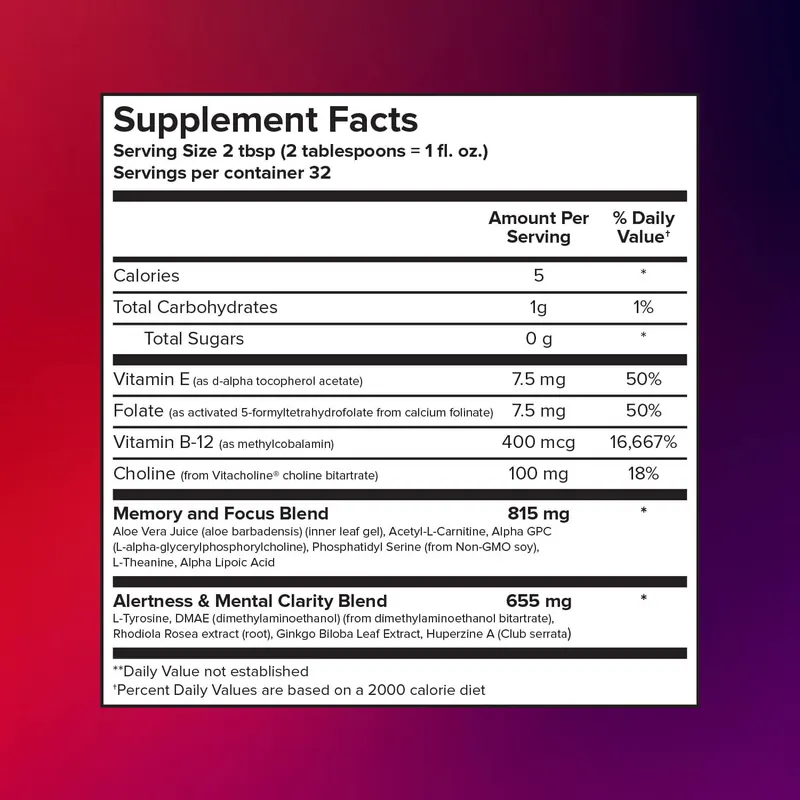
Four lines on the back have a number and a percentage next to them.
Then come two boxes.
One box weighs 815 milligrams and holds six names.
The other weighs 655 milligrams and holds five.
1,470 milligrams, eleven names, and not one amount.
That's legal, and plenty of labels do it.
But it changes what a careful reader can know.
A study tells you exactly what it gave people. A blend tells you only what everything weighs together.
So I did the one thing a blend leaves open to you.
I printed the studies behind each of the eleven names and laid them out beside the bottle, one page at a time.
Some names have a large trial behind them.
Some have a small one, in the wrong age group.
Some have nothing useful at all in healthy adults.
And one name works differently from the other ten, which is why it gets its own section below.
What I found isn't a scandal. It's a distance, and I'd rather you knew its size before you buy.
One more thing before the label, because most of you got here from one of our own advertisements.
Those ads talk about a boxed cereal, three foods, three drinks, and three words or phrases a man is supposed to be able to say.
None of that is in the bottle, and I won't pretend it is.
The honest version is in the section called "The bowl and the cup," and every headline we run is weighed in the guide linked at the foot.
The bottleThirty-Two Ounces From Mesquite, Nevada, Two Tablespoons at a Time
The bottle is heavy, amber glass with a metal cap, about the size of a bottle of maple syrup.
Thirty-two fluid ounces is thirty-two mornings at two tablespoons.
It's called Neurologic.
It's made by Liquid Health, a company in Mesquite, Nevada, that has sold liquid vitamins for years.
The flavor is berry pomegranate.
It goes in the refrigerator once it's open.
The company publishes a street address, a phone number you can call or text, an email and its customer-service hours.
It also prints its whole Supplement Facts panel on its own product page, at a size you can read.
That's more than most brands in this aisle will show you, and every number below comes off that panel.
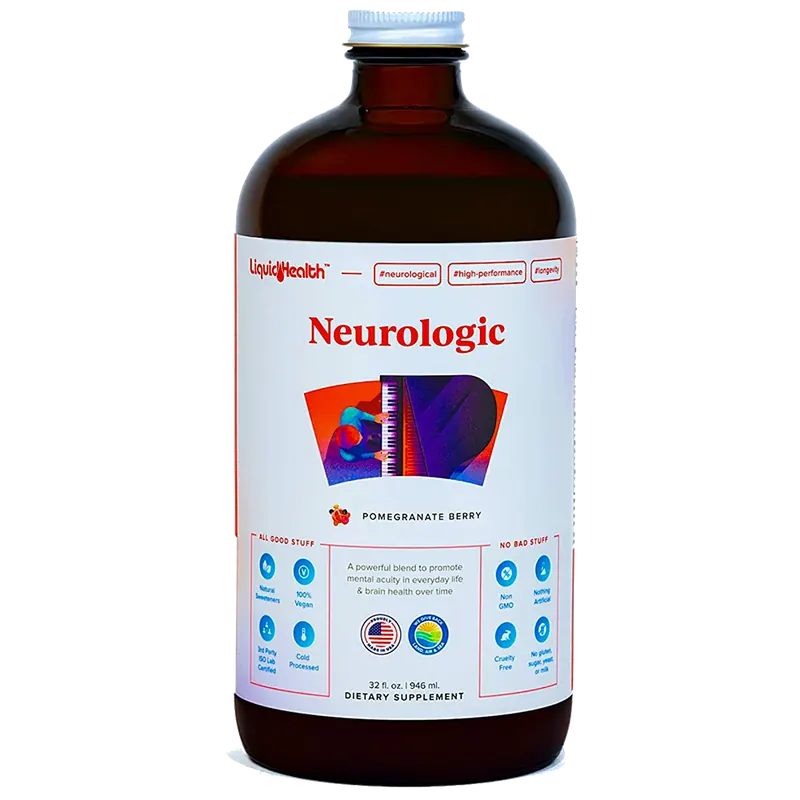
A reader sent me a photograph of this same bottle in April, standing in his refrigerator door between the milk and the orange juice.
He keeps the books for his wife's bakery and reads invoices before the sun is up.
He'd been pouring it for five months.
He wanted to know one thing: how much of what he was pouring was actually in there.

It's the right question.
This page is my answer to it, and for most of the bottle the answer is that nobody can say.
The panelTwo Tablespoons, Every Line in Order
Here is the whole panel for one serving of two tablespoons.
- Vitamin E, 7.5 mg, printed as 50 percent of the Daily Value
- Folate, printed as 7.5 mg and as 50 percent of the Daily Value
- Vitamin B12, 400 mcg, printed as 16,667 percent
- Choline, 100 mg, printed as 18 percent
- A "Memory and Focus Blend" of 815 mg: aloe vera juice, acetyl-L-carnitine, alpha GPC, phosphatidylserine, L-theanine, alpha lipoic acid
- A second blend of 655 mg, named on the label for alertness: L-tyrosine, DMAE, rhodiola root extract, ginkgo leaf extract, huperzine A
Five calories, one gram of carbohydrate, zero sugar.
The label says vegan, non-GMO, cold processed, third-party lab tested and made in the USA.
The front of the bottle carries one sentence about what it's for.
A powerful blend to promote mental acuity in everyday life & brain health over time.
— Liquid Health, front label of the bottle
"Promote" is a soft verb, and it's the right one for a supplement.
The label is more careful than the website, and that's usually how it goes.
The two blendsWhat a Proprietary Blend Tells You, and What It Leaves Blank
A proprietary blend lists names in order of weight, heaviest first, and prints one total for the group.
That's all the law asks of it.
So in the first box, aloe vera juice weighs the most and alpha lipoic acid the least.
In the second, L-tyrosine leads and huperzine A comes last.
Beyond that order, the label is silent.
You can't tell whether the phosphatidylserine is 300 milligrams or 3.
The order is a ranking, not a measurement.
Aloe vera juice is probably part of the liquid base, and it sits at the top of the first box.
That means the five names after it share whatever weight the juice leaves over.

I'm not saying the amounts are small.
I'm saying no one outside the company can check them, including me.
I can tell you what the studies used. I can't tell you what the bottle gives you.
So the rest of this page goes one name at a time, and it says which of the two I'm doing.
Ginkgo · second blendSix Years, 3,069 Adults, 240 Milligrams a Day, and No Difference From Placebo
Ginkgo leaf extract is the famous one, and it has the biggest trial of anything in this bottle.
The Ginkgo Evaluation of Memory study gave 3,069 adults aged 72 to 96 a standard extract, 120 milligrams twice a day.
They were followed for a median of six years.
At the end, the ginkgo group had lost ground at the same rate as the placebo group, in memory, attention, language and everything else measured. [1]
Six years, three thousand people, and the same result as placebo.
The National Institutes of Health says plainly that there's no conclusive evidence ginkgo helps with any health condition. [2]
It also notes that ginkgo may raise the chance of bleeding in people who take anything that thins the blood.
Now set the trial beside the bottle.
The trial's daily amount, 240 milligrams, would be more than a third of the entire 655-milligram box, which ginkgo shares with four other names.
And ginkgo is fourth of five in that box by weight.
So whatever this bottle holds, the largest trial ever run on the plant gave its volunteers far more, for far longer, and found nothing.
That's the most useful sentence I can write about ginkgo, and it isn't flattering to anyone selling it, this bottle included.
Phosphatidylserine · first blendSeventy-Eight Adults Aged 50 to 69, and a Placebo Group That Improved Too
Phosphatidylserine is the one with a trial in roughly the right age group.
Seventy-eight Japanese adults aged 50 to 69, all of whom had complained about their memory, took 100 or 300 milligrams a day for six months.
Scores went up in every group, including the placebo group.
Only the people who started with the lowest scores improved against their own starting point, mostly on remembering words after a delay. [3]

That's a modest result, honestly reported, and it's the best one in the first box.
The trial knew its dose to the milligram.
This bottle's phosphatidylserine sits fourth of six in the 815-milligram box, behind aloe juice, acetyl-L-carnitine and alpha GPC.
The label says it comes from non-GMO soy, which matters if soy matters to you.
One of the seller's store tags says there's no soy in it.
The panel says soy, so believe the panel and ask before you buy.
Theanine, rhodiola, tyrosineA Single Dose, Two Weeks of Night Shifts, and Short Demanding Spurts
L-theanine is the amino acid in green tea.
In Japanese men and women aged 50 to 69, the right age group for once, a single dose came with faster reaction times on an attention task. [4]
The summary of that study doesn't state the dose.
Neither does this label, so there are two blanks where a comparison would go.

Rhodiola has one small study I'd mention.
Fifty-six young physicians on night duty took a standard extract, one tablet a day, and did better over two weeks on tests of calculation, short-term memory and concentration. [5]
Young physicians on night shifts is not a man of 65 at his kitchen table.
And the bottle doesn't say how much rhodiola sits in the second box.
L-tyrosine leads that second box by weight.
A review of the research found it seems to help in short, demanding situations, and mostly when the brain's messengers are temporarily run down. [6]
Outside those moments, the same review found its usefulness limited.
Three honest studies, three different kinds of volunteer, and not one amount on this label to set beside them.
Huperzine A · second blendOne Name in the Second Blend Works Differently From the Other Ten
Huperzine A deserves its own sentence, so here it is.
It's a purified compound from a Chinese club moss, and it slows the enzyme that clears acetylcholine, one of the messenger chemicals nerves use.
The other ten names are nutrients, amino acids, plant extracts and a juice.
This one acts directly on the nervous system, in a measurable way, in small amounts.
In one small study, healthy adults took a single dose of 100 or 200 micrograms, twelve people per group.
Both doses slowed the enzyme in the blood, the higher dose held recall steady across sessions, and neither improved overall performance on the test battery. [7]
Micrograms, not milligrams, and last in the box by weight.
Being last tells you it's the lightest of the five names in the second box.
It doesn't tell you how light, and for this compound the amount is the whole conversation.
That's a reason to talk to your pharmacist or clinician before you start, not a reason to be impressed.
Bring the ingredient guide from the foot of this page, so they can see every name in the bottle.
The other fiveFive Names With Nothing Useful to Report in Healthy Adults
Then there are the ones where the pile of printed pages stays empty.
Acetyl-L-carnitine, alpha GPC, alpha lipoic acid and DMAE have no useful evidence in healthy adults that I could set beside this label.
Aloe vera juice is probably part of the liquid base, and nobody sells it for memory.
That makes five of the eleven names with nothing to compare, before we even get to the missing amounts.
So the honest summary of the blends is short: real ingredients, real research on a few of them, and no way to tell how much of any of them you're getting.

The four lines with numbersWhere the Arithmetic Works, and the One Line Where It Doesn't
Now the part of the label you can check with a pencil.
Four lines carry an amount and a percentage of the Daily Value.
Vitamin E: 7.5 mg is exactly 50 percent of 15 mg.
B12: 400 mcg is exactly 16,667 percent of 2.4 mcg.
Choline: 100 mg is 18 percent of 550 mg.
Three lines add up to the digit.
The folate line reads "7.5 mg" and, next to it, "50 %."
Those two figures can't both be right.
The Daily Value for folate on a US label is 400 micrograms, so fifty percent is 200 micrograms.
And 7.5 milligrams is 7,500 micrograms, which would be 1,875 percent.
Three lines add. One doesn't.
It's a misprint, either the amount or the percentage, and I won't guess which in print.
The company's phone number is on the bottle, and asking costs nothing.
The B12 figure looks generous and means less on its own than it seems.
Absorbing B12 gets less efficient with age, which is exactly why supplement amounts are printed in the thousands of percent.
A Cochrane review of fourteen trials in 27,882 adults with normal thinking found that B-vitamin supplements probably do little or nothing for overall thinking over five years. [8]
That review is about people who are not short of these vitamins.
A real shortfall of B12 gets more common with age, and a blood test answers that question in a week.
Choline is the line I'd point a friend to.
In 1,391 adults aged 36 to 83, the ones who ate more choline scored better on verbal and visual memory tests. [9]
That's food, not a supplement, and an association, not a trial.
But it's a real nutrient with a real amount printed beside it, and on this label that makes it the exception.
The claim I couldn't checkA Liquid Absorbs Better? No Comparison Has Been Published
The seller makes one more claim, and it's the one that justifies the whole format.
Its page says the liquid's absorbability is "vastly better" than tablets, capsules and chewables.
This means your body will readily take in all the vitamins we've sourced and formulated for you.
— Liquid Health, from the seller's own product page
I looked for a published comparison of this liquid against a capsule, or anything measuring how much of it reaches the blood.
I didn't find one, and the company doesn't publish one either.
The advantage of a liquid isn't chemistry. It's behavior.
It lives in the fridge door, it doesn't need to be swallowed dry, and you taste it, so you notice when you've skipped it.
The bowl and the cupThe Cereal, the Three Drinks, the Three Foods and the Word Test From Our Own Advertisements
Our advertisements have said, in one version or another, that a boxed cereal, three foods and three drinks have something to do with memory.
They've also said there are three words or phrases a man ought to be able to say, so here is the honest version of all of it.

Start with the bowl.
A frosted, honey-coated or chocolate cereal is mostly refined starch and added sugar, and a serving can carry more sugar than a cookie.
No cereal "ages the brain faster than time."
Nobody has measured any such thing, and that phrase was written to be clicked.
In the Framingham Heart Study, adults who drank more sugary beverages scored lower on tests of memory, and daily fruit juice went the same way. [10]
In a Brazilian study of 10,775 adults followed for eight years, the ones who ate the most ultra-processed food lost ground on tests of thinking about a quarter faster than the ones who ate the least. [11]
Both are associations across a population, not a sentence on your bowl.
And a quarter faster than slow is still slow.
The three drinks.
The "evening drink" in our advertisement is alcohol, and it has the strongest case behind it.
In 550 British civil servants followed for thirty years, the more a person drank, the faster their scores fell on a word-fluency test. [12]
Light drinkers had no edge over those who didn't drink at all.
The second is sugar in a glass: soda, sweetened tea, and the tall flavored coffee from the counter.
The Framingham finding above is about exactly those. [10]
The third, in one of our headlines, was coffee.
That was our worst headline, and plain black coffee and plain tea aren't what any of those studies were about.
The three foods are processed meat, fried food and the white-flour shelf.
Our advertisement says "just stop eating these three," and the research says something slower.
In 960 older adults followed for nearly five years, the ones whose meals looked most like the MIND pattern held their thinking scores better. [13]
That pattern is vegetables, berries, nuts, whole grains, beans, fish and olive oil, and the gap between the top and bottom thirds worked out to about seven and a half years of age.
Less sugar in the bowl and the glass. Less alcohol in the evening.
Keep the coffee. Eat more like the Mediterranean shelf and less like the vending machine.
Every one of those costs nothing, and none of them is in the bottle.
The bottle's two blends have no cereal, no coffee and no food group in them.
The three words, or the three phrases.
There's no such list.
What our advertisement borrowed from is the short mental-status test clinicians give in person: a few words to hold and repeat a minute later, the date, a sum, a drawing to copy.
It's read against your age and schooling by someone trained to do it, and a low score is a reason for a proper look, not a verdict.
Stumbling on a word when you're tired or being timed means nothing on its own.
If the worry behind the click is real, that's fifteen minutes with your own clinician.
And the advertisement about the things some men take every day.
Some kinds of daily medicine, including a few sold over the counter for allergies and for the night, are on the lists pharmacists check for people over 65.
Don't stop or change any of it because of an advertisement, ours included.
Put everything you take in one bag, this bottle included, and ask your pharmacist whether anything there is a poor choice at your age.
In that bag, the name to point at in this bottle is huperzine A, and ginkgo too if you take anything that affects clotting.
What it isn'tSix Things This Bottle Will Not Do
- It will not tell you how much of any of its eleven blended ingredients you're getting. The label prints two totals and no amounts.
- It will not match the ginkgo trial. That trial gave 240 milligrams a day for six years and found no difference from placebo.
- It will not act on any condition a clinician has named. It's a dietary supplement, and that's all it is.
- It will not make up for four hours of sleep. Nothing sold in a bottle does.
- It will not tell you whether you're short of B12. Only a blood test does that.
- It will not work on the days you skip it, which is the whole reason the format matters.
If that list annoys you, I'd rather you were annoyed now than in a month.

Real reviewsEighteen Reviews on the Seller's Page, and the Three-Star One Says the Most
The seller's own page carries eighteen reviews.
Thirteen are at five stars, four at four and one at three.
Fourteen carry the review platform's buyer mark.
One five-star review says the writer never received the product, which tells you how much a star count is worth.
Two mention a family member's health, and I've left those out on purpose.
I've kept four below, all with the buyer mark, and I deliberately kept the lukewarm ones.

NeuroLogic is one of my go-to brain health supports. I will always have it in my health cupboard. I've tried many supplements - most I wouldn't buy again. This one I've bought several times, 3 or 4 bottles each time.

Taste is very tolerable. We have almost finished the bottle. Have not seen a difference that we can tell.

This is a great combination. Unfortunately, I am having a bit of trouble getting used to the taste. I do appreciate that they have tried to give this a good flavor; I am just not into it.

The product I purchased seems to be effective and works. So far so good. But need more time to feel how effective it actually is. But would buy this product again.
The most useful one on that page is the three-star review.
A whole bottle, finished, taste fine, and no difference the writer could point to.
That's what an honest account of a supplement usually sounds like.
Some people notice something and some don't, and nobody can tell you in advance which one you'll be.
How it's usedShake, Pour Two Tablespoons, Back in the Door
The reader with the bakery keeps his bottle in the refrigerator door, between the milk and the juice.
That's why he never forgets it.
He shakes it and pours two tablespoons into the small glass that lives on the top shelf.
He drinks it cold, caps it, and shuts the door in about twelve seconds.

He takes it before the coffee, with a slice of toast.
That last part was his wife's rule, not the label's, and he keeps it.
- A real breakfast before the invoices, on the days he knows they'll be thick.
- Water on the table, refilled when the first column is done.
- Two tablespoons with the toast, every day, whether or not a hard morning is coming.
- A hard stop at sixty minutes, then five minutes at the back door doing nothing.
Three of those four things cost nothing.
The fourth is the one he pays for, and he'd tell you that's the right way round.

Five months in, he says less has changed than the label suggests, and more than nothing.
The morning when a column won't add still shows up after a bad night, because that morning is mostly made of sleep.
And he'll tell you himself he can't separate the bottle from the toast, the water and the sixty-minute rule.
That's not a testimonial.
It's a grown man refusing to overclaim on his own behalf, and I trust it more than five stars.
Who it's forWho It Suits, and Who It Doesn't
This is worth a look if:
- You've failed at capsules before, for reasons of habit rather than belief.
- You want something you'll see every time you open the fridge, and you'll actually use.
- You can hold two ideas at once: real ingredients, and amounts nobody outside the company can check.
- You're in the United States, because the seller ships nowhere else.
Give it a miss if:
- You want something that acts on a condition a clinician has named.
- You want to know exactly how much ginkgo, theanine or huperzine A you're getting. This label won't say.
- You have a soy allergy. The phosphatidylserine comes from soy, whatever the store tag says.
- You dislike berry flavors. One of the eighteen reviewers took a star off for exactly that.
- You're pregnant or nursing, or under a clinician's care and haven't asked first.
Where to get itSold Direct, and the Return Policy Is Store Credit
The bottle is sold direct, on Liquid Health's own site, and that's the only place this page links to.
The seller says it's also in a couple of big retailers, but its policy only covers the direct purchase.
The current price is shown there rather than here, because prices change.
I'm not going to print a number that goes stale.
One thing to know before you click.
The small print gives you an exchange or a store credit within thirty days, not a refund.
Which is why I'd rather you read this page properly than order on a feeling.
See the current price on Liquid Health's site
A liquid blend of vitamins, choline and eleven botanical and amino-acid ingredients, poured out two tablespoons at a time from an amber glass bottle.
CHECK AVAILABILITYSold and shipped by Liquid Health, Inc., Mesquite, Nevada · Ships within the United States only · 30-day exchange or store credit, not a cash refund
Every line on the panel, both blends included, is written out in the ingredient and advertising guide linked at the foot of this page: what each name is, what the research does and doesn't show and at what amount, and which of our own headlines it does and doesn't support.
Print it and take it to the pharmacy counter if you take anything daily; huperzine A is the name to point at.
QuestionsWhat Readers Ask Before Their First Bottle
Questions readers ask
Is this medicine?
No. It's a dietary supplement sold in the United States.
No regulator has approved it for any health condition, and the label says so.
Why doesn't the label say how much ginkgo or phosphatidylserine is in it?
Because both sit inside proprietary blends, which only have to print a total weight and the names in order.
The first blend is 815 milligrams with six names, and the second is 655 milligrams with five.
Is there enough ginkgo in it to match the big trial?
Nobody outside the company can say. The trial gave 240 milligrams a day, more than a third of the whole second blend, and still found no difference from placebo after six years.
What is huperzine A, and should I ask someone about it?
It's a compound from a club moss that slows the enzyme that clears acetylcholine, so it acts on the nervous system directly.
Yes, ask your pharmacist or clinician before you start, and bring the ingredient guide so they can see everything in the bottle.
Why does the folate line say 7.5 mg and 50 percent when those don't match?
I don't know. The other three lines add up exactly against the Daily Value table, and the number on the bottle is the place to ask.
How long does a bottle last?
Thirty-two fluid ounces at two tablespoons a day is thirty-two mornings. Call it a month.
Will it work?
I can't tell you that, and you should be wary of any page that does.
A few of the ingredients have some research behind them at amounts this label doesn't print. What it reliably gives you is a twelve-second daily habit you're likely to keep.
Your advertisement was about a cereal, or three foods, or three drinks. Where is that on this page?
In the section called "The bowl and the cup," in full, with the studies. The short version: less sugar in the bowl and the glass, less alcohol in the evening, keep your plain coffee, and eat more like the Mediterranean shelf.
None of it is in the bottle, and the ingredient and advertising guide at the foot goes through every headline we run and says which ones overstate.
Your advertisement said something about three phrases, or spelling three words. Is there a test I can take?
Not on a screen. The words and phrases come from the short mental-status test clinicians give in person, read against your age and schooling.
Nothing begins at a word. If the worry behind the click is real, ask your clinician for the proper test.
What if I don't like the taste?
One of the eighteen reviewers didn't. The seller will exchange it or give you store credit within thirty days, but not your money back.
Where does it ship?
Within the United States only, at the time of writing.
The short versionEverything Above, in Sixty Seconds
- A 32-ounce liquid from Liquid Health, a Nevada company that publishes an address, a phone number, an email and its full label.
- Two blends, 1,470 mg, eleven names, and no amount for any of them.
- Ginkgo: 3,069 adults, six years, 240 mg a day, no difference from placebo. [1]
- Phosphatidylserine: 78 adults aged 50 to 69, a modest result only in those who started lowest. [3]
- Theanine, rhodiola and tyrosine: one study each, in volunteers unlike you or at doses nobody printed.
- Huperzine A acts on the nervous system directly; ask your pharmacist before you start.
- Four lines with numbers; three add up exactly, and the folate line doesn't.
- The cereal, three drinks, three foods and the word test from our own advertisements: less sugar, less alcohol, keep the coffee, eat more like the Mediterranean shelf, and no test on a screen.
- A thirty-day exchange or store credit, not a refund; ships within the United States only.
Where to find itThe Bottle, the Blends, and What You Can Know Before You Buy
The reader with the bakery is on his sixth bottle.
He still has a morning when the column won't add after a bad night, and anything that promises otherwise isn't being straight with you.
What changed is twelve seconds at the start of the day, in front of an open fridge.
And he knows exactly what he bought, including the eleven names nobody weighed for him.
Check the current price and availability
A liquid blend of vitamins, choline and eleven botanical and amino-acid ingredients, poured out two tablespoons at a time from an amber glass bottle.
CHECK AVAILABILITYSold and shipped by Liquid Health, Inc., Mesquite, Nevada · Ships within the United States only · 30-day exchange or store credit, not a cash refund
P.S. If you take one thing from this page, take the distance between the studies and the blends: the trials weighed every dose, and this label weighs two boxes.
P.P.S. If names or columns have been slipping for a year, book the blood test before you buy anything. [8] A bottle takes a month and still doesn't answer a question a laboratory answers in a week.
P.P.P.S. And if you do buy it, put it in the door, not the back of the shelf, because the whole case for this format is that you can't open the milk without seeing it.